I’ve been rewatching my life, again and again, but now the movie has gotten caught on a loop—the film roll has been snipped, and the projector is stuck whipping the detached strip, again and again.
Since my dad died (almost 20 years ago), I’ve tried to tell a spacious, generous truth of who I am, where I came from, but it never seems like it’s enough. All I get is a cage around my chest and a tannic, stringent dryness—the kind that comes from bitter tea and makes you rub your tongue along the roof of your mouth, your teeth, searching for wetness.
Now, I can’t remember my father at all. He is THERE in my memory, but flat and unmoving, like in the photos on my bookshelf.
This year, my entire world has collapsed on itself, and underneath the rubble, I see what I’ve truly wanted:
a generosity
for myself.
And maybe, from there, I can afford him the grace I’ve hoped I’d be big enough, loving enough, brave enough to muster.
So here I go.
DECOMPRESSING THE TRUTH
I’ve heard people claim they had HAPPY, easy childhoods, and I’ve always asserted myself as one of these people. It was the easy, daughterly, and morally correct way to let the “better” side of the story take up weight, especially since my dad’s life was so noble, so brave, and his death, so sudden and violent.
And in some ways, it IS easier to sweep everything under a single narrative.
Here am I now, as a mom, and I know more intimately than ever the effort, energy, and soul-bearing that goes into raising a child, whether intentional or not. But if “intention” commands reality, then everything would be a delusion, as intentions are rarely ever manifested by speech or announcement.
They are pervasive and revealing—subconsciously, intrinsically linked to everything we make, say, and do, across our past, present, and future.
My dad: the man, the legend
My dad, in many ways, was tenacious about our enjoyment, fulfillment, expansion, and well-being… or at least, his understanding of what those meant.
At his brightest, he was the hunter of delicious ice cream, history museums, locals-only theme parks buried behind side-roads, and premium buffets at luxury hotels because he knew everything was ours to taste. These weren’t acts of obligation, but a natural extension of his own dreams: the fruits of his labor and duty were ours to be relished because we were of him. My memory as his daughter is punctuated by shimmering, humming moments in timespace—stacked between the skyscrapers of Hong Kong, or wafting from all those family barbecues in our perfect little tract home in Irvine when he’d have a few beers, and he’d so wonderfully shed the weight of his own presence.
He joked often about the luxuries of his own childhood—stale French fries from McDonald’s, watching Willy Wonka through his neighbor’s window, and a single bottle of Coca Cola, given to him by his half-brother who hid him outside the restaurant while he dined indoors. (To this day, I hate that fucking loser half-brother and refuse to remember his name. This is MY truth, and I decide where my generosity goes.)
My dad would share these snapshots, then tell us to laugh, stand up straight in church, and be grateful to God that we were going to eat churros and yule logs at the Disneyland Christmas parade.
“They were just stories,” he’d say. “Everything is good and different now.”
As if he were reaching back into time to tell himself.
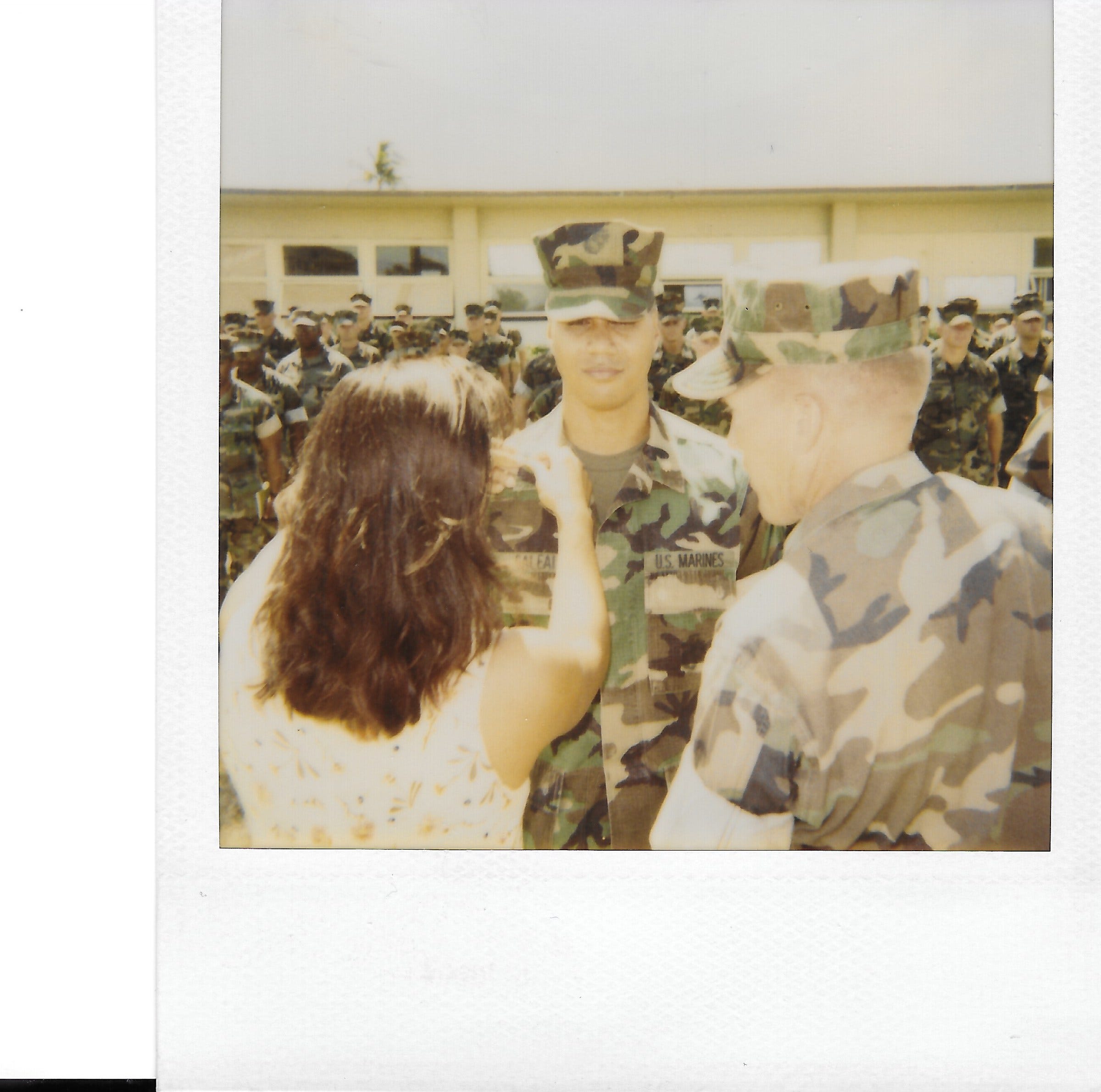
Growing up, my father, to me, was composed of legends and hero myths.
He had traveled far and long, outsmarted and endured the kinds of hardship that were “regular” to his culture—unrelenting duty and hierarchy, induced modesty by way of humiliation, and the pressing envy of those for whom it was already too late because they didn’t have what it took. Not like he did.
He was one of the most ambitious people of his island at the time and one of the few to believe that fortune and purpose could be achieved beyond his little rock of a home and its pettiness, myopia, and arrogant illiteracy. Some dickhead doctor at the hospital fucked up his Naval Academy application, so he worked at a Wendy’s for a year before going to Oregon State, and eventually became the highest-ranked Samoan in the Marine Corps.
How is that not incredible?
Stories I heard from everyone but himself.
Today, I see these not as myths, but fables of the tension it creates to abandon your world, yet be invisibly, unconsciously constrained by the indentations it has left on you.
He built a home that shielded us from his hardships, but he still decorated our walls with talismans, omens of his culture and upbringing that I had to honor, with no explanation or reason except BECAUSE HE SAID SO! Honestly, I don’t think he even knew he had brought them with him, and that they were constantly looming over the dinner table, school assemblies, and field trips like watchful, tattling deities.
I know this because I always heard them. I did.
I heard them and their silent, suffocating logic—impossible to decipher, but absolutely necessary to respect.
Punctuation is not the sentence
I knew of him, but I must admit he was difficult to decipher. He gave me the snapshots, the origin stories, the vignettes, the jokes. But I never knew what to get him for Christmas, which friends of mine he would like, what would please him, or what would set off the splitting of the Earth.
To say this feels like condemnation, but if I’m going to be generous with myself, I have to stop filling in the blanks for someone who is dead and cannot correct or challenge me.
The truth is this: I loved and admired my dad, but I had enormous difficulty knowing him beyond his expectations and hopes for me, and my fear of him.
First off, he was rather remote. It was the nature of his work. The pressure, the ambition were things he kept away from us because it was “grown up stuff”—war and military and risk, why would you want your kids to bear that? But it did create a moat around him, and I sensed (and was told, in steely glares and silences) that I was not to cross it.
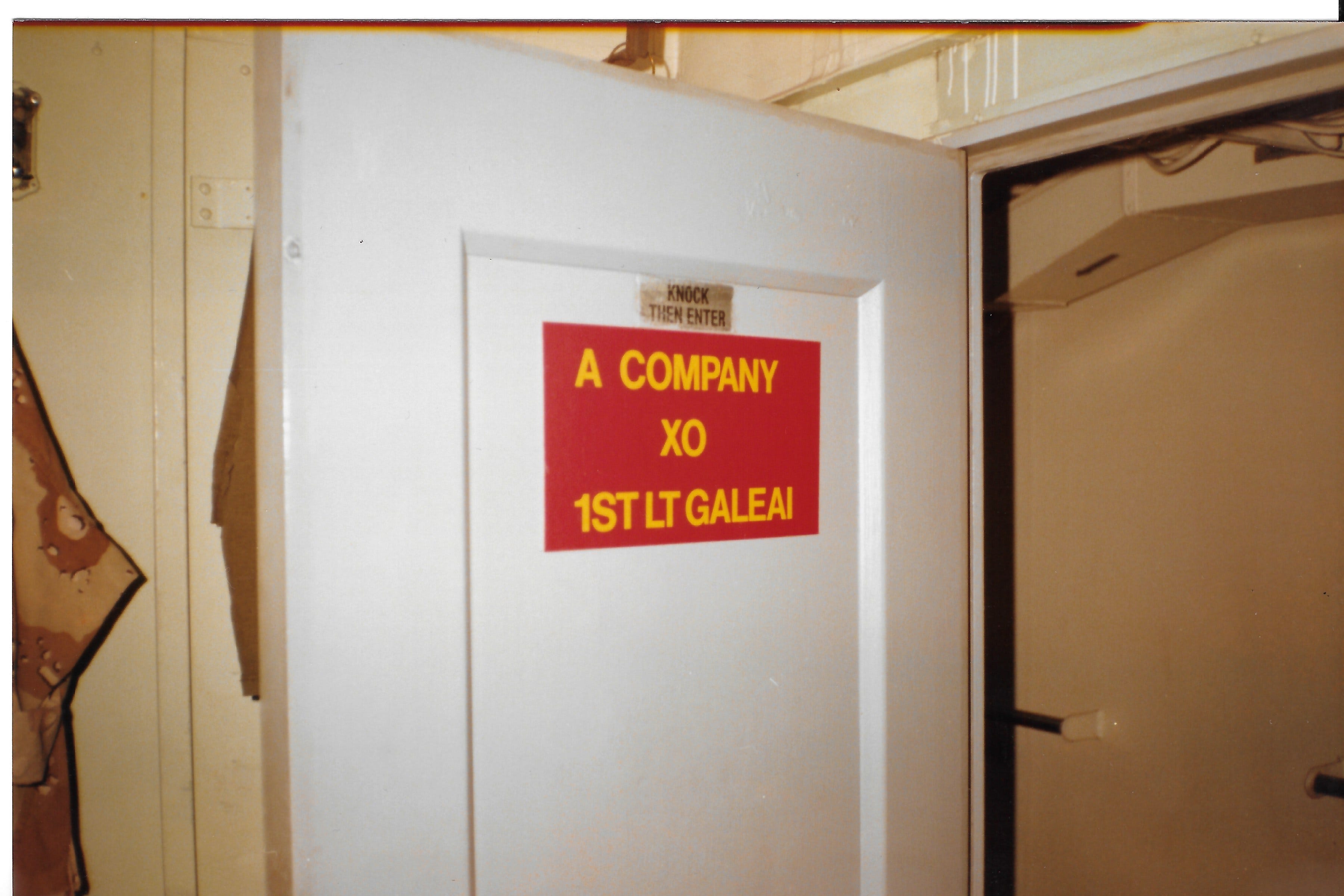
Second, it was also hard to know him because he was quite terrifying to me.
He was a mystery, with a shapeshifting energy that could be expressed as incredible charisma and warmth. He was a leader’s voice and gravity, the kind that would inspire me to write lists of all the ways I could be EXCELLENT, just like him. I could be a writer, a lawyer, a journalist, or someone who could help if I just applied myself. He made me feel like Icarus, resurrected and given another chance at greatness.
And at the slightest degree to the left, he would morph into a rage that was as consuming as a massive black hole and the heat of a thousand Suns, all at once. Hands and words and looks would go flying like asteroids, and there I was, on the ground, rearranging the pieces of myself into someone that would be acceptable.
JUST DO AS YOUR FATHER FUCKING SAYS, ICARUS!
“Maybe I’ll get it this time!” I would think with hope, again and again, until I gave up.
I do think he knew this and wielded it intentionally, though maybe, less so and reluctantly, in his final months.
I CAN’T DO MATH! I’M NOT FUCKING SORRY!
In 8th grade, I received a big, fat, glaring F in math. It was about to be Christmas break, and I knew that I was about to spend the entirety of it imprisoned while all of my friends got to eat Christmas candy at the base’s shoppette, ride the bus to Camp Foster and Mihama, and talk to boys on AIM and Myspace.
“I know what I’ll do. I’ll give it to him on his birthday. He will be in a good mood! That will lessen the blow,” desperate, idiot, 13-year-old me.
I also considered whether I should slam and break my hand in my window to inspire sympathy and deflect my impending corporal punishment. I did, but my hand did not break. And, I ruined his fucking birthday.
Here’s the real punchline, though: even if it did break, nobody would’ve noticed it amidst the astounding tag-team between my dad and mom, not even me. I saw so many stars that night that I forgot I had slammed my hand until the next day, when I could barely hold a pencil. I would later play with my futility and misery through other forms of self-harm and degradation that I will not awaken here because those demons have earned their sleep.
Why didn’t it occur to him that I hated math or wasn’t as smart as he’d hoped?
Why didn’t it occur to him, or my mother, that I would be in so much pain?
Why wouldn’t he, they, anyone just fucking LOOK AT ME?
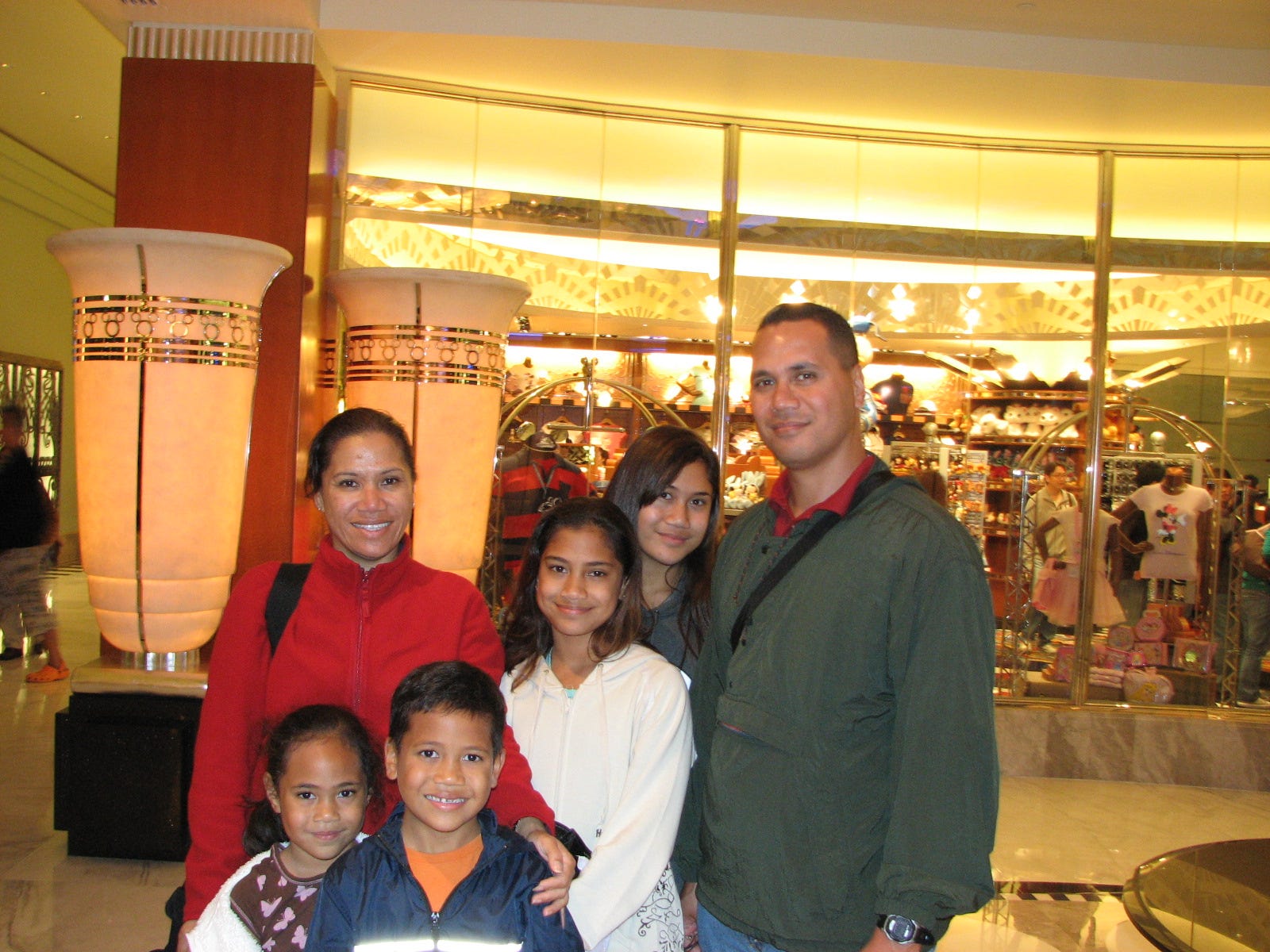
A few months later, we would all go to Hong Kong, and we would become perfect and dandy.
We would ride double-decker buses and squeal quietly at how fancy Mandarin food is served with all the heads and claws and eyes bugging and bearing at you. We would drink pulpy pineapple juice from McDonald’s, and he would snuggle my baby sister after she was lightly bullied by myself and my second sister. He would be the only one to spot Goofy get accosted by a handsy eight-year old and point it out to all of us so we could belly-laugh over Mickey waffles and scrambled eggs. It would be enough happiness to think that he trusted me and that my loneliness was just an illusion.
I would forget that he told me to cover my wrists after that boy slammed me against the rock wall. I would forget how humiliated he and my mother looked when I had to pick up trash on base after betraying the only friend I ever loved. I would forget how lonely I felt and how much I just wanted to go back to California, and turn all of this into a sweaty fever dream.
“I CAN do this,” I thought. “WE can do this. Everything is going to be okay. I can be GOOD!”
Nearing the end.
Then we would land in Hawaii, and he and my mother would abandon me, yet again. He would disappear into his Commanding Officer responsibilities, and my mother would immerse herself in caring for four children, making friends, and playing politics with everyone except families that might’ve had a friend for me.
They would never admit it, but by now, I had taught them to be highly suspicious of me, and that it would be necessary for my safety and their convenience to sentence me to an all-girls Catholic school halfway across the island. To match, we moved onto the top of a hill that jutted far out into the ocean, was barred by a sentry, and could only be reached by a long, winding road. He received a historic house that had seen World War II and a plate with his name and rank. The grass was always sharp and dry, no matter how green. He had done something really great and gotten what he wanted.
I was safe now because I was out of reach and nowhere to go but back within their walls, back to the angry, wordless deities. Back to the internet.
I’m just like you.
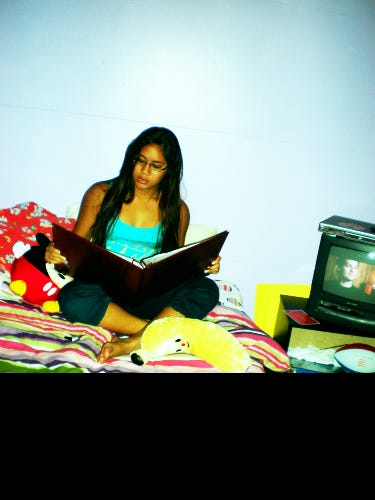
Every so often, my dad would drive my sister and me to school in his very little, very silver, very practical Saturn sedan. This seemed like the only place he could never be in a bad mood—driving us over the Pali in the early weekday mornings.
With every block we passed, every yard we closed as we approached my school, I would close my eyes and begin to dissolve myself so that everything would pass through me—all the signs that I was an outcast, a conundrum, or at my most, a stinky and grumpy teenager.
And as we pulled up before that ancient little school, there was so little left of me.
But there was enough of me to see him. Right before I got out of the car, he would turn back to say goodbye, and there he was, as I loved him: the dad who taught me that yellow, powdered Gatorade was the ONLY acceptable hydration. The one who would take us to get Slurpees after school. The one who promised that so long as I stayed close to my family, to God, everything would be okay.
“Goodbye! I’ll be okay. I’ll do my best. Thank you for everything, ” I would say, unbeknownst that I was whispering across into the crevasses and folds of time.
I would truly, truly, truly mean it, even as I felt myself fading and disintegrating with each step up those dreadful, hollow wooden stairs amidst all the girls who reminded me of how weird and distant I was. He would zoom off in the Zoomster (what he had named that little Saturn—I told you he was funny!), and I would bless him, despise him, and wish he would come back to save me!
Please save me! All of your excellence and power and anger—
SHOW that same anger, that same fire, to my loneliness, to all of the things that hurt me
and taught me
how difficult I was
to weather,
to tame,
to understand,
and to love.
Tell them they are wrong and that—actually,
ironically, karmically,
fatefully—
I am just
like
you.
Saturn, Father Time, Father Issues
I ask myself often: what more can parents give to their kids, other than to live widely, truly, and fully? We lived in his world, his career. As a mother now, I’m not really bothered by that.
But the least he could’ve done was allow me a world of my own within his.
Everything I felt and lived was on the margins and in secret. I’d hop in the car and pretend, and accept because he and my mother worked so hard for this. That school, the Disneyland trip, the berating and humiliation were all in the same category because it was all for me.
It was very confusing to be watched so closely, yet always feel so profoundly and almost stubbornly unknown.
And since the theme of this writing is finding the GENEROUS truth, I will admit that I wanted to admire him and, in many ways, I did, but the proximity needed to KNOW him was too great a risk. If he were too close, he and my mother would see me and all of the discrepancies between who I SHOULD be and who I actually was, and from them, harvest myriad opportunities to suspect, surveil, and compress me.
I will also admit that, by the age of eleven, I decidedly liked it when he was gone on long trips. And by age fifteen, the age at which he was killed because of his job, I think I had given up on knowing him closely.
It is, perhaps, tongue-in-cheek funny that I would grow up to believe myself spiky, volatile, and terrifying—and that these were qualities that would make me hated but powerful. Ask my college boyfriend, my siblings, my mother, those coworkers from the ice cream shop, and my roommates after I’d had too much to drink. I have a fucking temper, one of my own brand and style, and in some bizarre logic, it makes me feel connected to him. Not just through blame, but a sense of shared accountability and empathy.
It’s hard to be this way. I don’t mean to sound self-pitying, but it is really hard. Angry and conscious of your own extraordinariness (both the reality and potential of it). Deeply seeing and generous, and yet, with a fucking chip on your shoulder. Very loving and wanting to be liked, but also remote, complicated, and hard to understand.
So to say that my childhood was “happy” is a compressed, tight-lipped truth. It was punctuated by happiness, love, and admiration for my father, of course. But it also bred in me an unremovable fear, an inevitable striving, and a mythology of my own difficulty,
my own secrecy,
and a fear of ME,
because I was
(as I described him)
incredibly
volatile,
hard to understand,
and
capable of a terrifying anger.
But I am so much more than all of that. So was he. We just never got the chance to know that as fully as I think we both would’ve wanted.
A human wish: that in the second his life left his body, he saw me across time and space. Maybe even now, he KNOWS who I am, who I was, who I will BE. I wonder what an alien would say about that—humans are SO funny, little, and strange!
What a silly, little girl thing to say. That’s what I’ve always been, and am, even now. A silly little girl.
The more I say this, the more I feel myself (and him) come back to life.
Happy 60th birthday, Dad.